
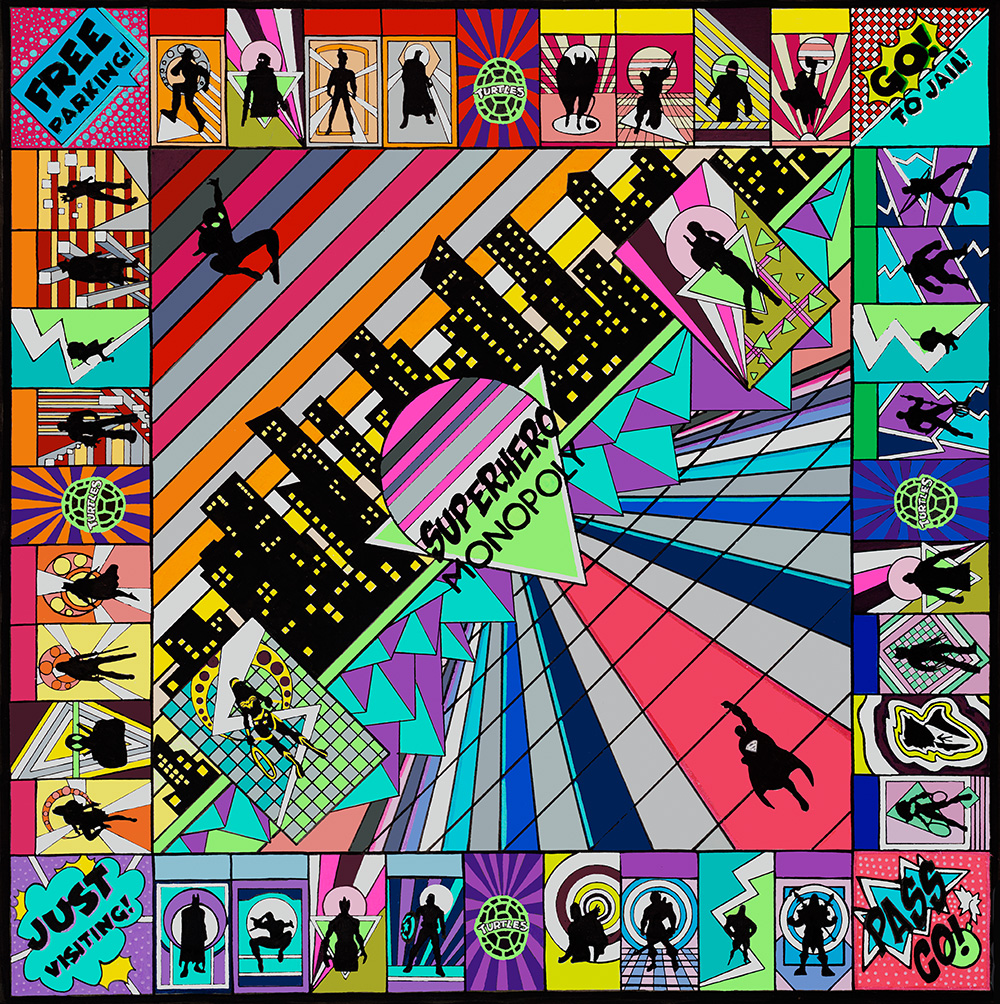
Comic book superheroes explain what is takes to run a project across the board:
Topics:
projects, lifecycle, management, manager, methodologies, the triangle, stakeholders, deliverable, team, charter, scope, budget, schedule, planning, baselining, milestones, dependencies, resources, risk, procurement, communication, ceremonies, integration, backlog, whiteboard, closure, software tools, office(r), code of ethics, body of knowledge
1. Projects, Programs & Portfolios

“Different ways of organizing work to reach a desired result”
– Skeletor
Each of these are systems intended to deliver value for organizations. Value in the form of new products, services, or results that meet the needs of customers or end users. Value in the form of positive social or environmental contributions. Or value in the form of enabling the organization to transition to its desired future state.
Project Management Institute definitions:
- Project: a temporary endeavor undertaken to create a unique product, service, or result. Projects have a beginning and an end to the project work or a phase of the project work. Projects can stand alone or be part of a program or portfolio
- Program: related projects, subsidiary programs, and program activities that are managed in a coordinated manner to obtain benefits not available from managing them individually
- Portfolio: projects, programs, subsidiary portfolios, and operations managed as a group to achieve strategic objectives
Although distinct from each other with different forms of managing scope, change, planning, monitoring, and success, they all roll up to supporting the strategic objectives of the organization.
2. Project Lifecycle

“The series of phases that a project passes through from its start to its completion. Project teams use a certain development approach, depending on the nature of the project and its deliverable(s), to manage the life cycle of the project. Common development approaches are predictive (waterfall), adaptive (agile), and hybrid.“
– He-Man
Previously, a project was defined as: a temporary endeavor undertaken to create a unique product, service, or result. Projects have a beginning and an end to the project work or a phase of the project work.
Projects come in many shapes and there’s a variety of ways to undertake them. When a project’s deliverable has uncertain requirements and complexity, project teams can opt to explore the requirements using iterative and/or incremental project life cycles to adapt to changes more easily and avoid the risk of wasted work, rework, and having to change approach – which is costly and time consuming.
Iterative and incremental life cycles help project teams get feedback quickly and verify their work to understand the true customer requirements. This can likely be done faster and more accurately than with heavily planned, static documentation from a predictive life cycle.
This is not to poo-poo on the predictive (waterfall) approach. When a project has a well-defined scope, schedule, and cost, the project team can more heavily plan up front and reduce uncertainty as the project moves forward. A predictive approach can work quite nicely, especially if there are templates and documentation from previous, similar projects.
3. Project Management

“Applying what you know, the skills you have, the tools you’ve learned, and the techniques you’ve picked up to guide a project from beginning to end.“
– Captain America
Now that we have project and project lifecycle defined, let’s dive into project management. PMI defines it as: the application of knowledge, skills, tools, and techniques to project activities to meet project requirements. Project management refers to guiding the project work to deliver the intended outcomes.
I really like this definition because the folks that ‘do project management’ are practitioners. As previously mentioned, projects come in many different shapes and sizes and must be approached differently. So to do project management effectively, you know that there is an art and a science to it.
PMI’s 12 project management principles, published in their legendary and consistently updated Project Management Body of Knowledge (PMBOK) publication:
- Change
- Stewardship
- Team
- Stakeholders
- Focus on Value
- Systems Thinking
- Leadership
- Tailoring
- Quality
- Complexity
- Risk
- Adaptability and Resiliency
4. Project Manager

“Performing a variety of functions, a project manager facilitates the project work so it delivers the intended value to the organization.”
– Spiderman
Defined in the PMBOK, a project manager is: “the person assigned by the performing organization to lead the project team that is responsible for achieving the project objectives.”
Using this definition, who is ultimately responsible for the project? Is it the project manager or the project team? Taking stakeholders and project team definitions into account, I’d argue that the project manager is a part of the project team and everyone on the project team is responsible for the project’s success.
It probably depends on the organization and how much authority is given to the project manager. It’s common for the project manager to not have any direct reports and thus have no real ‘authority’ over the folks involved in the project. That’s part of the challenge of the role.
However, this can also be seen as an opportunity. Especially if the organization supports the notion, the project manager can be positioned as impartial. They are trying to get the best work out of the project team as well as bridging the expectations from leadership to achieve the project objectives.
Now let’s address some other common confusion – in the form of acronyms. Project management can be shortened to ‘PM’ and so can project manager. But guess what? So can program manager, portfolio manager, product manager, and even product marketer. Just be aware of that.
5. Project Methodologies

“A project methodology is an approach, practice, technique, or framework that can be applied to a project to increase its likelihood for success.“
– Batman
Projects have many characteristics but in general project work tends to range from definable work to high-uncertainty work. A predictive (waterfall) methodology tends to work well with definable work while an adaptive (agile) methodology tends to work well with high-uncertainty work. Hybrid is a third common methodology where a combination of approaches are used.
- Predictive: with predictive methodology, the plan drives the work. As much planning as possible is done upfront. Project requirements are identified as much as possible. Project teams take advantage of the high certainty and often execute project activities in a serial manner.
- Agile: with agile methodology, the team plans and replans as more information becomes available from review of frequent deliveries. In an agile environment, there is an expectation that requirements will change. This is unlike predictive where the team will try to limit change as much as possible. Agile combines both iterative and incremental approaches to adapt to high degrees of change.
- Hybrid: with hybrid methodology, any combination of approaches can be used. For example, a project might utilize agile methodology during the development portion of the project due to uncertainty, complexity, and risk. The project might shift to a predictive methodology for the rollout phase of the deliverable, which might be handled by a different team.
The goal of project management is to produce value in the best possible way given the current environment. It doesn’t matter if that way is agile or predictive. The question to ask is “how can we be most successful?”
6. Project Management Triangle

“Want a quality project delivered on time and budget? Manage the triple constraint.“
– Storm
The project management triangle – aka the iron triangle, the golden triangle, the project triangle, and the triple constraint – is a model. It proposes (3) constraints on project quality: cost (budget) scope (deliverable), and time (schedule). Each are interconnected and must continually be balanced. When a change is made to one constraint, a change is necessary in the others to compensate or quality will suffer.

For example, increasing scope likely means increasing time and cost. A tight budget likely means increased cost and reducing scope.
The project management discipline empowers project managers and project teams with tools and techniques to organize their work to meet these constraints.
If you need to finish a project in a shorter time, you can throw more people at the problem, but this will raise the cost – unless by doing the task quicker reduces cost elsewhere in the project by an equal amount. This is where lean and agile methodologies really shine.
7. Project Stakeholders

“Anyone involved in or affected by a project.“
– Black Canary
Really? That seems like potentially a lot of people. Yes, the PMBOK defines stakeholders as: an individual, group, or organization that may affect, be affected by, or perceive itself to be affected by a decision, activity, or outcome of a project, program, or portfolio.
The project manager will strive to have a productive working relationship with stakeholders throughout the project. Depending on the characteristics of the project and the environment, this alone can be a challenge. It could be 5 people, 50 people, or 500+ people. To keep track, the project manager will run a stakeholder analysis to gather quantitative and qualitative information about everyone to determine whose interest should be taken into account and when. To add complexity, there may be different stakeholders at different phases of a project and their power, influence, and interest may change as the project unfolds.
What does working and collaborating with stakeholders look like? The project manager will work with them to introduce the project, extract requirements, manage expectations, resolve issues, negotiate, prioritize, problem solve, and facilitate decisions. This calls on the application of soft skills such as active listening, interpersonal, leadership, and conflict management.
8. Project Deliverable

“Ideally, projects produce quality deliverables that are focused on adding value to the organization or end-user.“
– Scarlet Witch
The PMBOK defines a project deliverable as any unique and verifiable product, result, or capability to perform a service that is required to be produced to complete a process, phase, or project.
Value and quality are both important to a deliverable. The deliverable is intended to produce value (which is the worth, importance, or usefulness of something). Different stakeholders perceive value in different ways. A customer may define value as their ability to use a specific feature or having the product function in a certain way. Organizations focus on business value through financial metrics. Society might see value as how groups, communities, or the environment is affected by a project deliverable.
Since value is the ultimate indicator of project success, project teams might shift focus away from simply creating a specific deliverable and instead focus on intended outcomes that are more inline with the vision and purpose of the project. It’s important for organizational leaders to support the project team’s and other stakeholder’s understanding of both the deliverable and the intended outcome from the deliverable.
Quality is another related key term. Quality ensures that deliverables meet acceptance criteria. Quality has several dimensions which might include: performance, conformity, reliability, resilience, satisfaction, uniformity, efficiency, and sustainability.
9. Project Team

“The project team is central to the project, performing the work to produce the project deliverable(s).“
– Cyborg
If stakeholders are anyone involved in or affected by a project, the project team is a specific group of stakeholders that are central to the project. The PMBOK defines a project team as: a set of individuals performing the work of the project to achieve its objectives.
The project team produces deliverables which add value to the organization and end-user. In this way, the project team needs clear direction from customers and end-users regarding project requirements, outcomes, and expectations. The team can gain an understanding of these through the project plans from a predictive/waterfall type approach, or the team can learn as they go from feedback loops which are a primary feature of an adaptive/agile approach.
The role of a project manager helps facilitate the team’s understanding of the project and the work to be done, as well as establishing the culture and environment that enables a high-performing team. Teams can even produce a team charter – deliberately or informally – which details operating guidelines and other team norms. This is common in agile working environments. A team charter is representative of the team’s culture. It operates within the organization’s culture but reflects the team’s ways of working and how they will interact.
10. Project Charter

“A document that details the business case and formally authorizes the project.
– Dr. Fate
The project team produces the deliverable which ultimately adds value to the organization and end-user. It’s the project charter that outlines the business need and intended value add. It can serve as an ‘authorizing document’, which effectively states the organization is moving forward with a project.
With the project charter offering details about the goals and objectives of the project, along with a clear statement of the business need, it helps the project team understand what they are working towards. Armed with this information, the project team can better identify opportunities and risks, increasing the likelihood of a positive project outcome.
A project manager uses the project charter document as approval to form a project team to achieve the project outcomes. In this early start up phase, a high-level roadmap is developed, initial funding requirements are established, the project team and resource requirements are defined, and milestones are created.
11. Project Planning

“The organizing, elaboration and coordination of project work, done to various degrees depending on how well project requirements are understood initially.“
– Iron Man
Who participates in planning? Stakeholders participate in and shape planning. What is planning? Planning organizes, elaborates, and coordinates project work throughout the project.
Time spent planning should be appropriate for the project. If scope and requirements are well understood, up front planning along with a predictive/waterfall approach is likely. If scope and requirements are not well understood, planning might be minimal upfront and done for each development cycle/sprint. If the latter – and certainly in the case of an innovative deliverable – the project team is highly involved with the planning for each iteration of work.
So it’s often the case that project deliverables necessitate the type of planning necessary. For example, construction projects require significant up-front planning to consider materials, logistics, and delivery. Product development, particularly high-tech products, may use continuous and adaptive planning to allow for stakeholder feedback and factor in technological advances.
Regardless of the type of planning done, planning usually calls on a lot of estimating. Work effort, duration, costs, people, and physical resources are all estimated. As the project moves forward, the estimates may change.
12. Project Budget

“Usually estimated during planning, budget is the extrapolation of all project work/activities that need to get done.“
– The Flash
The PMBOK defines project budget as “the approved estimate for the project or any work breakdown structure (WBS) component or any schedule activity.” Basically it’s the cost of all the units of work that you have planned for in the project scope.
As with scope, the budget is estimated. Estimates are inherently uncertain and associated with risk. And like scope, the budget will likely evolve from the initial agreed upon estimates.
How is the budget estimated? Looking at the (estimated) scope, project activities get an estimated cost. These costs are aggregated to develop the cost baseline. This cost baseline is then allocated across the project schedule to reflect when the costs are incurred. This is usually managed by the project manager. If there is a sudden change to the budget for a period of time, the work will likely need to be rescheduled.
A project budget will likely include contingency reserve funds in the case of an adverse event (anticipated by a risk analysis). Ultimately, the project budget is the cost baseline, plus the contingency reserve.
13. Project Scope

“The details of work that needs to get done to produce the deliverable.“
– Firestorm
The PMBOK defines scope as “the work performed to deliver a product, service, or result with the specified features and functions.”
Project scope entails what needs to be produced. The definition above has 3 key parts: the work, the deliverable, and the requirements. Sometimes requirements are not clear. In this case, the scope cannot be fully planned for and might have to evolve over the course of the project. As mentioned, when the scope is unclear or complex, an adaptive/agile approach might be useful for the project work. If requirements are clear, the scope can be fully planned and a predictive approach should work.
Scope is one of the three project constraints along with budget/cost and time/schedule. Together they are called the triple constraint or project triangle among other names. If there is a change to any of the three at any point in a project, the other two will be affected. For example, if the budget is suddenly cut, something has to give – likely a quality requirement or a reduction in scope.
How is scope decided on and how might it change during the course of a project? Stakeholders. They define and prioritize requirements and scope for the project team. If there is a decision to change the scope after a project is underway, the budget and schedule will have to be adjusted somehow. If scope continually expands, this is the scenario commonly called scope creep.
Regardless, scope is planned early on and is likely the precursor to setting the schedule which includes project activities with durations, dependencies, and sequences.
14. Project Schedule

“A time-based model that shows when project work will be done.“
– Superman
A project schedule is a model that plans how a project’s activities will be executed, taking into account durations and dependencies.
Along with scope and budget, it is one of the triple constraints. All three are usually developed in a similar fashion in the planning stages of a project through estimating and coming to a consensus (baselining). Planning the schedule can use predictive or adaptive approaches.
In a predictive environment, the scope is broken down into specific project activities, which are then sequenced, and then it’s estimated how long the team will take to complete the activities. If at any point the project is behind schedule or the schedule needs to change, more resources may need to be added (which affects budget).
In an adaptive environment, the scope is also broken down, but usually not as much. Sprints or iterations are planned, aimed at delivering quickly and getting feedback before more work is planned and scheduled. The project team can more easily adapt to changes, which theoretically lowers the risk of affecting the budget.
15. Project Baselining

“Approved estimates for budget, scope, and schedule.”
– Hawkman
Project baselining is the process of developing baselines for each of the triple constraints: budget, scope, and schedule.
A baseline is effectively the approved version of each, representing a consensus of the estimates that are embedded in each.
Baselines are developed in the planning phase of a project and will be continuously useful as the project progresses to evaluate variance of actual performance. If there is a change in the project that affects any of the triple constraints, the project team will have to adapt. Depending on the complexity of the project and how it is being managed, this process might be reprioritizing the backlog, or rebaselining the project.
Suffice to say, baselines are set in the planning stage but are continuously revisited – and potentially updated – over the course of a project.
16. Project Milestone

“Any significant point or event in a project.”
– Green Arrow
When integrated into the project schedule, milestones can have planned dates. This is helpful to gauge performance against the plan as the project progresses.
By signifying project work and performance with milestones, it allows the project team to focus and get a sense of momentum and progress. If managed well, project milestones can be something the entire project team – or even organization – can rally around.
Milestones depend on the type of project. Construction projects will have different milestones compared to product development projects for example. Project approval, requirements gathering, planning, hiring, resource allocation, training, testing, stakeholder signoffs, and deployment are all types of milestones.
17. Project Dependencies

“Different types of relationships between tasks.”
– Thor
Project dependencies are relationships between tasks where a task has to be completed or started before another task can begin. Dependencies are key elements of the overall project schedule, along with dates, milestones, and durations. Mapping dependencies will help the project team complete tasks in the correct sequence.
There are four types of dependency relationships:
- Mandatory: where it is contractually or inherently required for a task to start or be completed before another can begin
- Discretionary: where it is best practice or preferential of the team to start or complete a task before another can begin
- External: where project activities are related to non-project activities out of the team’s control
- Internal: where all project activities are under the team’s control
Project dependencies are likely identified in the project’s planning phase but will need to be continuously managed if there is a change in the project, particularly if one or more of the triple constraints are affected.
18. Project Resources

“A project resource is any asset that is needed to complete a project. Resources are usually classified as people resources or physical resources.“
– Hawkeye
People resources refer to the actual people doing the project work, managing the project, advising, or assisting. This includes knowledge and skillsets as well as the budget and time necessary to complete tasks.
Physical resources are all the non-human resources needed such as goods, materials, equipment, software, and licenses.
Developed in the planning stages of a project, a resource management plan should describe how project resources are acquired, allocated, monitored, and controlled. Additional planning for physical resources might include lead time, delivery, storage, inventory, disposition, and other logistics. Environmental sustainability and the organization’s use of materials and natural resources are more considerations.
Like scope, schedule, and budget, resources are estimated during planning and then continuously managed throughout the project. Any adverse event, risk, or change to a project will affect the triple constraint and thus resources will have to be adjusted. For example, if a project needs to be delivered sooner, additional resources are needed to meet that delivery. If the project’s budget is suddenly cut, resources may be cut or positioned differently.
There is always an implicit or deliberate intention to minimize the waste of resources and maximize the value of the project deliverable.
19. Project Risk

“Aspects of project uncertainty and their potential presence, adding to a project’s level of complexity.“
– Hulk
The PMBOK defines risk as “an uncertain event or condition that, if it occurs, can have a positive or negative effect on one or more objectives.” Notice that risk is not only negative (threats). Risk can be positive (opportunities).
Like scope, schedule, budget, resources, and many other project elements, risk is estimated/anticipated in the planning stages of a project and then continuously addressed throughout the project.
Embedded in planning for risk is an organization’s risk attitude, appetite, and threshold. These will influence how risk is addressed. Responses to risk should be appropriate for the significance of the risk, ideally cost effective, realistic within the environment of the project, agreed upon by stakeholders, and owned by someone – perhaps the project manager, a centralized support team like a PMO, or another governance body.
Some projects may have risk around the deliverable meeting regulatory requirements. In this case, a predictive approach may be useful to build in testing, documentation, processes and procedures that aid in passing requirements. If a project has risk around stakeholder acceptance, an iterative approach to the deliverable may be necessary to generate feedback before developing more features and functions of the deliverable.
Ideally, project teams will maximize positive risks and decrease exposure to negative risk.
20. Project Procurement

“Procurement is the process of acquiring the goods, services, and physical resources needed for a project that the organization does not have available internally.“
– Aquaman
Like many other project processes, procurement can happen at any time during a project, but if planned for can be performed smoothly.
Project managers likely won’t be the role that deals with negotiations, contracts, laws, or regulations that are necessary for procurement. However they work with the procurement experts, facilitate the process, integrate the procurement into the project work, and monitor performance.
Procurement is one of the primary parts of a project that you develop a plan for, along with scope, budget, schedule, project team, resources, and risk.
21. Project Communication

“The process of exchanging information with stakeholders of a project.”
– Wolverine
Many posts in this series have mentioned the triple constraint (aka project triangle) of scope, schedule, and budget. They are the most important aspects of a project, but apart from these it’s communication that drives every phase of a project.
Communication is the process of exchanging information with someone. In the context of a project, determining how, when, how often, and under what circumstances stakeholders should be communicated with is important to plan for and execute. Project managers are skilled at identifying, analyzing, and prioritizing stakeholders to plan for how communication with flow throughout the project. They are constantly trying to understand what communications are sufficient to manage stakeholder expectations. Various tools and communication channels will be adopted to execute the communication plan.
Depending on what the communication goal is, three types of communication can be considered:
- Push communication where information is sent one-way, such as in an email, memo, status report, or voicemail. You won’t get immediate feedback or be able to gauge reaction or asses understanding of the information.
- Pull communication where a stakeholder can autonomously use an intranet, internal repository, or online search to find information.
- Interactive communication where information is sent two-ways, such as face-to-face interactive meetings, chat, or phone conversations. Engagement is deeper with this type.
What is largely being communicated as the project moves along? Plans, progress, and projections.
22. Project Ceremonies

“Specific types of time bound activities done at various stages of a project to facilitate communication.“
– Wonder Woman
A project ceremony is a term usually associated with adaptive/agile project management, but can certainly be considered for predictive/waterfall. Essentially, a ceremony is a time bound activity that the project team undertakes to effectively communicate information that is necessary to plan, strategize, execute, perform, and learn from a project.
Common ceremonies include:
- Daily Stand-Ups where the team meets and micro-commits to each other to uncover problems and ensure work is flowing smoothly. A standup is usually time boxed to no longer than 15 minutes. It’s a common practice to have each person say what they have completed since the last standup, what they are planning to complete between now and the next standup, and what if any barriers, risks, or problems that the rest of the team should be aware of. Standups can also be a time where the task board is walked through in some way and this can be facilitated by anyone on the team.
- Backlog refinement and prioritization where the team considers the list of tasks and activities that need to get done to determine the necessary order, sequence, or method to do the work. Since this deals with strategy, backlog refinement and prioritization is typically handled by a product/project owner and facilitated by the product/project manager.
- Sprint/iteration planning where the project team considers the prioritized work and estimates what can be completed in the time frame (two week sprints are common). The team learns from the work completed in a sprint and effectively re-plans for the next sprint.
- Demonstrations/reviews where the project team periodically shows the work that has been done in the sprint so they can get feedback on the work that has been done to inform the next sprint.
- Retrospectives where the team considers the work that has been done so they can learn, improve, and adapt a process for better work in the future. Retrospectives can happen at any time but are usually run after a sprint, a milestone, a release of some kind, or at the closure of a project.
23. Project Integration

“Happening continuously throughout the project, integration is the process of coordinating all project elements.“
– Magneto
As we have seen, there are many elements to a project. Integration is the process of coordinating all of the elements such as tasks, resources, stakeholders, priorities, and risk to ensure the project meets its goals. Integration is a crucial part of project management, especially when the project is complex, several teams are involved, and processes interact.
A project manager is skilled at project integration. They coordinate multidisciplinary teams which might include people internal and external to the organization. They facilitate the way teams will work and manage the project as a system, with all of its dynamic interdependencies.
Like other processes, integration will happen continuously throughout the project. If there is a change to the project (affect on scope, schedule, or budget), the accepted changes have to be integrated into the project plans and communicated out to stakeholders. Integration also happens at the end of the project when the deliverable is integrated into the company’s value stream.
24. Project Backlog

“A prioritized list of work to be done on a project; continuously re-prioritized as the project moves forward.“
– Deadpool
Each item on the list rolls up to the business case the project is trying to solve for. Ideally the backlog is prioritized and re-prioritized so high-priority items are worked on and completed until the project (deliverable) is complete and accepted by the organization.
A backlog represents how the team adapts to plans throughout the project and how changes will be incorporated. In projects where an adaptive/agile approach is taken, there is an expectation that work will evolve and adapt to additions to the project backlog. In fact, changes to the project are encouraged. A project manager usually works with the product/project owner to manage expectations around adding scope or items to the backlog and how that might affect the budget, schedule, and availability of resources.
The number of backlog items that are in progress at any given time is telling. When there are too many items in progress, a project team can lose focus. It’s often the case that limiting in-progress work is more efficient in the long run. A Kanban board is effective at displaying backlog, in-progress, and completed tasks.
Backlog refinement is a key ceremony/event where the project backlog is considered and (re)prioritized to set the work for the upcoming sprint or iteration.
25. Project Whiteboard

“A method of making project information accessible and transparent to stakeholders.“
– Cyclops
A whiteboard can display anything really. It can go beyond just being useful in a brainstorming session. A whiteboard can be a place where information of any kind can be displayed as a way of communicating something to stakeholders. It can show project status, progress towards a goal, or the health of a project. The key is that the information is public, easily available, accessible, and transparent.
The agile project management methodology classifies a whiteboard as an information radiator, a visual display that conveys important information to a team or organization. A whiteboard can be physical or digital. And just like most elements of a project, can be continuously updated to reflect the team’s progress.
26. Project Closure

“The final phase of a project where deliverables are accepted.“
– Groot
Project closure is the final stage of a project’s lifecycle. In this stage, deliverables have been completed, accepted, it’s ensured that the project has been executed successfully, and any loose ends are tied up.
The project sponsor and/or any applicable governance bodies who provided leadership and authority over the project manager and project team now monitors project outcomes to ensure intended business benefits are realized. This process is different at every organization.
Here is a list of common activities that happen in this final phase:
- Reconcile expenses and close out any contracts with vendors or subcontractors
- Confirm deliverables by ensuring they meet quality standards and fulfill project objectives
- Get final and formal approval from project sponsor and stakeholders
- Communicate results of the project to the team, vendors, and stakeholders
- Document lessons learned and discuss successes and future improvements
27. Project Management Software Tools

“Tools to effectively manage the complexity of a project.“
– Star-Lord
Project management is critical to ensure success, especially in today’s fast-paced business environment. Discussed prior, project management involves coordinating all the different elements of a project such as planning, organizing, and managing resources, risk, and stakeholders to achieve the goals of the project within a deadline. The process can be done manually, but to limit the challenge, risk of errors, and time-consuming nature of project management, software tools can be leveraged. Some are available online for free, others are purchased.
Common key features of project management software tools are visual aids like Gantt charts, Kanban boards, and whiteboards; analytics and reporting dashboards; capacity planning and tracking; AI capabilities like projecting outcomes and risk; and integrations with other common software like Google Drive, Slack, Zapier, Adobe, and Salesforce.
Popular tool include: Adobe Workfront, Asana, Basecamp, ClickUp, Jira, Microsoft Project, Monday, Smartsheet, Trello, and Wrike.
28. Project Management Office

“Project Management Offices are governing bodies that provide oversight on projects within an organization.”
– Drax
PMOs assist the project managers and the project team. The acronym ‘PMO’ most commonly refers to a project management office, but can also refer to program or portfolio management office, or even an individual as a project management officer.
The character and function of a PMO varies between organizations but commonly:
- Share project results across the organization
- Guide and support projects with best practices, methods, templates, training, and coaching
- Aid consistency, continuous improvement, knowledge transfer, and change management
- Control contingency reserve funds to mitigate risk
29. Project Management Code of Ethics

“The four values that were identified as the most important by the project management global community.”
– Joker
The Project Management Code of Ethics and Professional Conduct is attributed to the Project Management Institute (PMI). It is based on the four values that were identified as the most important by the project management global community: responsibility, respect, fairness, and honesty. This code can be adopted by an individual or an entire profession to establish the expectations for moral conduct. Specific to PMI, it is expected that all members, volunteers, certification holders and applicants comply with the code.
Here is the code in detail:
- Responsibility is our duty to take ownership for the decisions we make or fail to make, the actions we take or fail to take, and the consequences that result.
- Respect is our duty to show a high regard for ourselves, others, and the resources entrusted to us. Resources entrusted to us may include people, money, reputation, the safety of others, and natural or environmental resources.
- Fairness is our duty to make decisions and act impartially and objectively. Our conduct must be free from competing self interest, prejudice, and favoritism.
- Honesty is our duty to understand the truth and act in a truthful manner both in our communications and in our conduct.
30. Project Management Body of Knowledge (PMBOK)

“A resource published by the Project Management Institute (PMI), compiling the processes, best practices, terminologies, and guidelines accepted as standard practice within the project management industry.“
-Teenage Mutant Ninja Turtles
The PMBOK is meant to guide project professionals with the fundamental practices needed to achieve organizational results and excellence.
While past editions were more focused on processes and specific approaches, this current edition embraces the full spectrum of project approaches. It’s heavily focused on principles and performance domains which represent groups of activities that are carried out for effective project outcomes, regardless of the approach used by the project team (such as waterfall, agile, or hybrid).
The current 7th edition’s performance domains are: stakeholders, team, development approach and life cycle, planning, project work, delivery, measurement, and uncertainty. These performance domains have been discussed throughout the 30 topics in this series.
Continued Reading

Creative Operations
Cranium Carnival

Find the formula, figure the field, finance the function, resource the role, and risk the responsibility
Cohesive Storytelling
Shoots & Ladders

Who are you? What’s your story? How are you telling it? When and where? To who? Your story is your strategy.

Clue to the
Messaging Suite

Eight rooms await. Each holds a clue of a different way your story takes shape.
The imagery for Project MGMT comes from my original artwork, Superhero Monopoly.
🎟️ Book a Free Session
🪬 Explore Services
Leave a Reply